Laws
Q
Cornering
Infringement1.
Players should at all times be trying to stay in line with the lateral movements of the ball.
2.
No Bully-player or Fly may touch the ball when in a Cornering position or coming from a Cornering position.
Figure 10 – Cornering: open play (Q-1/Q-2)
3.
No Behind may attempt to make-ground-running-with-the-ball when in, or coming from, a Cornering position. However, a Behind may make a tackle, bring the ball under control and/or kick the ball from a Cornering position.
Penalty: Set-Piece-Bully (Free-kick only for extreme and deliberate – “professional foul” – infringements).
A player is in a Cornering position in the following situations:
3a.
when the ball is in a Tightly-Formed-Bully, and the player is:
a Bully-player not fully bound within the Tightly-Formed-Bully
a Fly not behind the centre of the Tightly-Formed-Bully
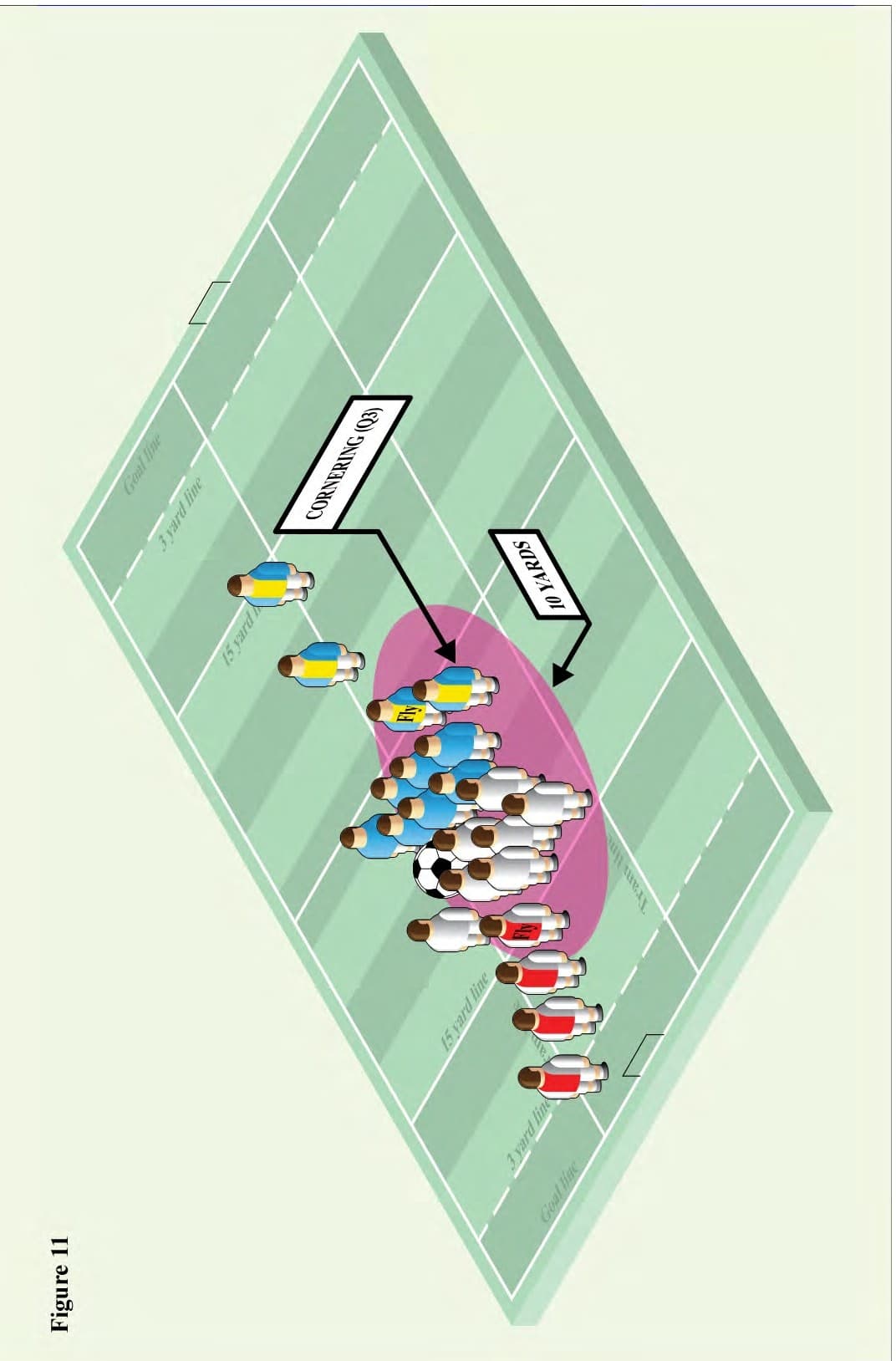
a Behind within ten yards of the Tightly-Formed-Bully (penalty: Free-Kick); the exception is for a designated Goals who is in the goal when the Tightly-Formed-Bully is within ten yards of the goal. Such a player may play the ball (e.g. kick it), but not “make-ground-running-with the-ball”.
a Behind not directly in line with a Set-Piece-Bully or Tightly-Formed-Bully may not “make-ground-running-with-the-ball” in the subsequent passage of play (the passage of play does not end until the ball is next deemed “Dead”).
Figure 11 – Cornering: Tightly-Formed-Bully (Q-3a)
3b.
when the ball is in open play and the player has failed to track the lateral movements of the ball during that passage of play.
Cases of Cornering 3(b) can be hard to determine. Some guidelines:
Behinds who are not in line with the ball when it is in a Tightly-Formed-Bully are ALWAYS cornering in the subsequent play. N.B. watch that a Behind who tackles from a Cornering position does not then set to “make-ground-running-with-the-ball”.
Bully-players and Flys must make as much effort to track the lateral movement of the ball as they do to advance up the field in pursuit. Staying wide of the line of the ball for any reasonable length of time puts them in a Cornering position. In practice, most lines of running of Bully-players should be diagonal or sideways not straight up the field. N.B. the movement of the ball cannot bring a Cornering player back onside, the effort must be made by the player.
Umpires will tolerate a certain “zone of tolerance” to allow players to show a reasonable effort to get in line with the ball. Less tolerance should be shown to Flys and Behinds than to Bully-players.
In essence, players of both sides should make every effort to stay in line with the ball; those outside the umpire’s (or umpires’) “zone of tolerance” should not interfere with play.
Other than when an attacker is going-along-the-line (see Sneaking-on-the-Line), when a player is making-ground-running-with-the-ball, all players should make a reasonable effort to be in line with the ball.
In extended periods of kicking between the Behinds, the Bully-players tend to spread across the field; those, from both sides, in the wider areas for a sustained period should be told to get more central and avoid playing the ball (or making a tackle).
The umpires are advised to communicate as clearly as possible before penalising players, although in practice this is not always possible.
A Set-Piece-Bully to the non-offending team is the default re-start after a penalty of Cornering.